A White Summit Is Not Always Snow
A white summit in a photograph may be snow, cloud, sunlit rock, or glare. Use shape, texture, and weather clues to describe the scene more accurately.
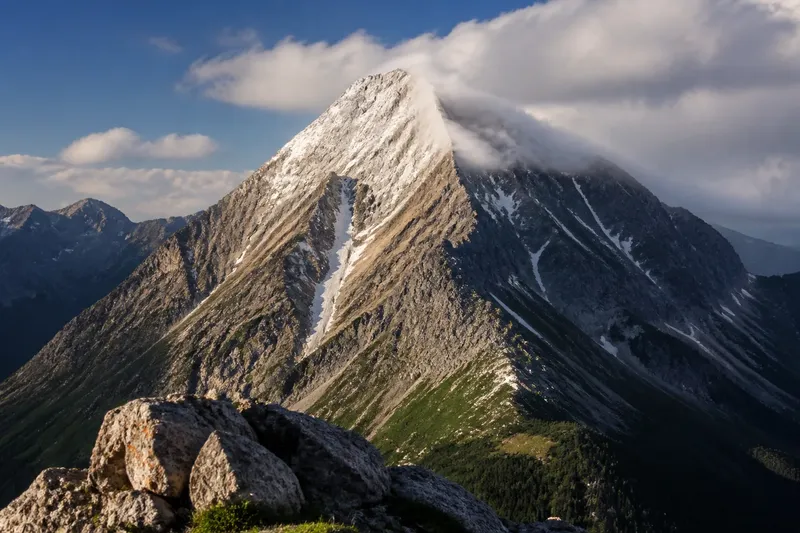
Is the white summit in your photograph snow, or is it a cloud, bright rock, or glare? Start with the pale area’s shape and position, then compare its edges and texture with the mountain around it. Color alone rarely settles the question.
Read the pale area against the mountain
Snow usually follows the mountain’s surface. It can collect in hollows, cling to ledges, or form streaks down gullies, with dark rock interrupting the white. A snowfield may have an irregular edge that traces the terrain rather than the skyline.
Cloud behaves differently. It may soften or erase the summit outline, wrap around a shoulder, or extend beyond the peak into open sky. A cloud can look like a cap, but a pale veil over the ridge may conceal where the mountain ends.
Exposed rock and direct light offer another explanation. Pale granite, limestone, and other light-colored stone can reflect strong sunlight, especially beside darker slopes. If ridges and folds remain visible through the bright patch, bare rock is plausible.
Match the pattern to the likely cause
If the pale area follows gullies and ledges, consider snow first
Snow tends to collect in sheltered hollows and shaded cuts in a slope. Look for broken edges, scattered patches, and dark rock showing through. These details make snow plausible, but a shadowed rock face or cloud crossing the slope can create a similar pattern.
If the skyline fades or the white extends into the sky, consider cloud
Cloud is a strong possibility when the summit’s outline looks blurred, partly missing, or wrapped in a pale mass. Check nearby peaks in the same frame: if their tops also disappear into haze, the effect may be atmospheric. Thin cloud can be hard to distinguish from glare in a small or compressed image.
If the summit is bright but sharply defined, consider bare rock and direct sun
Light rock can appear nearly white when sunlight strikes it while nearby faces remain in shade. Look for crisp texture, continuous ridges, and color changes that follow the rock surface. If the bright area preserves the slope’s structure without a distinct snow-like edge, reflected light is a reasonable explanation.
If the image looks washed out, consider glare
Glare can bleach detail across a summit or spread a pale glow around the brightest part of an image. It may occur when the camera faces low sun or when haze scatters light between the camera and mountain. A white patch with little visible structure offers less evidence about the surface than one with clear terrain detail.
Check evidence beyond the white patch
Look at shadows elsewhere in the photograph. A bright face turned toward the sun beside a dark neighboring slope may point to illumination rather than a change in surface. Cloud shadows can also cross terrain, while snow may be visible in both sunlit and shaded areas, though it looks different in each.
Consider the image’s limits, too. A distant summit may occupy only a few pixels, and sharpening, compression, or exposure adjustments can blur the boundary between cloud, snow, and rock. Enlarging a crop can reveal captured detail, but it cannot restore detail the camera never recorded.
If you can identify the mountain, location, and season, compare the photograph with another view from around the same time. A second angle may show whether the pale area sits on the slope or floats beyond the ridge. A mountain weather report can provide context, but a report for a valley or different elevation may not describe summit conditions.
Which clues help distinguish snow from cloud or rock?
Can a cloud make a summit look snow-covered?
Yes. A cloud crossing a peak can form a bright cap or veil, especially when the ridge is partly hidden. Look for a blurred outline or pale material continuing into the surrounding sky.
Can bare rock really appear white?
Yes. Pale stone in direct sun can look much lighter than the same rock in shade. Texture and ridges that continue through the bright area support the possibility of exposed rock.
Does a blue or gray tint prove the patch is snow?
No. Shade, haze, white balance, and reflected sky color can tint snow, cloud, and rock alike. Treat color as one clue among several.
What if the photograph gives no clear answer?
Describe what is visible without naming its cause: “a white patch on the upper slope” is more precise than calling it snow. If another view clarifies the scene, you can revise the description.
Describe uncertain evidence without overstating it
Say you are captioning an invented photograph of a sharply outlined summit with a bright streak in one gully. The image has strong glare and no visible texture. First, note the streak’s position in the gully; that pattern makes snow plausible. Next, check the skyline: it remains sharp, so cloud is less evident. Finally, account for the glare, which hides surface detail. The honest caption is “a pale streak, possibly snow,” not “fresh snow covers the summit.”
That distinction helps in captions, trip notes, and conversations about mountain weather. “The upper ridge is obscured by a white veil” reports what the photograph shows; “fresh snow covers the summit” makes a stronger claim about the surface. Keep observation and inference separate, then update the description if clearer evidence becomes available.
For a white summit in a photograph, shape, texture, shadows, and surrounding cloud can narrow the possibilities, but one image may not show enough to distinguish them. When the clues conflict, describe the pale feature plainly and leave its identity open.